Us and Them
Is the "deep division" often cited in popular media just hot air?

“Give any species too much rope,
[and] they’ll fuck it up.”
- Roger Waters, “Too Much Rope”
We’re living in an age of irresponsibility. Now, being that just about every age throughout history was an age of irresponsibility, one might rightly assume that to be a moot declaration. The difference with the current epoch is that access has been syndicated in ways that would have been a pipe dream mere decades ago.
The Anarcho-Syndicalist dream of “power to the people” was a good idea on paper. But just like every other idea that comes from that political cant, that’s as far as it goes. In fact, if you look at stated goals, just about every left-of-socialist public policy initiative since Marx has been an utter and pitiful failure (of course, that camp is also very clever in twisting narratives to make it appear that anything that wasn’t a victory was someone else’s fault). History has never been that radical, at least not where institutions are concerned, and any democratic reforms have, traditionally, been wrought under the auspices of some form of regulatory agency.
But now, something has changed. Now, anyone with a gizmo, a little know-how, and a story to sell and buck to make can jump into the public idea pool. Again, it sounds nice to have a democratic market of ideas. In execution, without mincing words, it’s been a disaster.
Turns out that gatekeeping in industry had a practical outcome: to weed out people who were just going to turn the respective industry into a race to the bottom. With that in mind, anyone with a logical bent should be able to see the writing on the wall when you give everyone access to the means of communication: nuance and logical care go out the window and the reckless hordes wind up dominating the narrative and public discourse because they exercise no restraint.
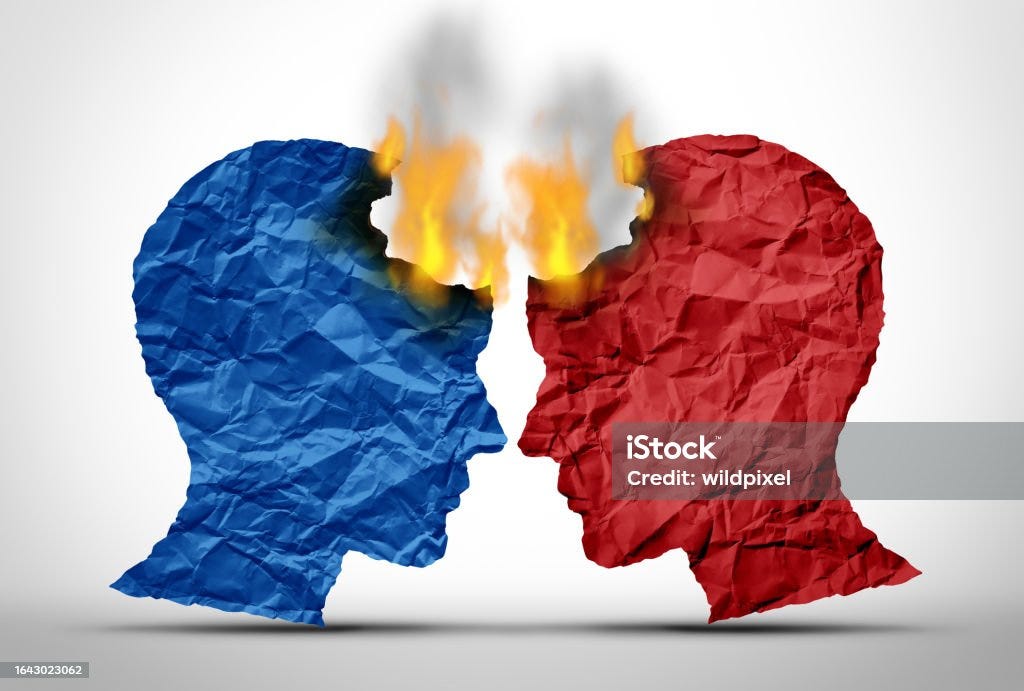
With that preamble out of the way, we can now arrive at the meat of the thesis: the putative “deep divisions” that are irreconcilable between groups or tribes of people - in particular, politically. Prior to everyone having information stuck in their faces (and marketed to them with pinpoint accuracy by algorithms), it would have been too difficult for the idler to bother with contentious issues because it would have been what Marshall McLuhan called “hot media”; its consumption required at least some critical thinking training and an urge to seek out and tease out truths and ideas.
And then along came the spider of user-friendliness, and all of a sudden, people were inundated not only with information, but with only specific information, and they were not properly inoculated against the hazards that came along for the ride. Now, combine that influx with anonymity and lack of accountability, and presto!: instant moral panic. Those were bad enough when they didn’t need a catalyst.
It pays to take stock, however. It’s very common to have a selection bias by default that focuses on negatives and ignores positives. This is only natural, being that positive outcomes don’t require resolving, and aren’t putting people at a loss. In this sense, it’s highly likely that we’ve already become anesthetized to all the benefits of advanced technology because it’s obfuscated by the negative social outcomes. But this poses a further problem.
My sense is there’s a feedback loop happening: online negativity and rancour are prominent problems, and people fixate on that negativity, hypothesize the world is getting worse, and then feel more compelled to run to ideologies as shelter from the problem when really, the problem just exacerbates itself. But again: the problem may just seem way more prominent.
But here’s what I won’t abide: the media types that latch on and exacerbate the problem with innuendo and inflammatory headlines replete with bellicose language and derisive references to stereotypes. I’m talking of the people who castigate, for instance, the “Radical Left” or “progressives” by grouping them all in one basket, then proceeding to insult them. They know it galvanizes their audience, and nuance doesn’t sell, so they make what money they can from a dying industry by milking peoples’ prejudices and simultaneously worsening the divide. This is the opposite of what a public intellectual should be doing, as far as I’m concerned.
So as I said: like many things that are only lucrative to a point where they become a dried-out husk, the paradigm of social media and instant information that caters to a bias is a race to the bottom, and it will be interesting to see how far it goes before it comes to a screeching halt. I try to not blame the general public (although their lack of accountability almost inexorably contributes to the sullying of new developments with pure potential), but I have no problem pointing my finger at the Michael Shellenbergers and Ben Shapiros of the world whose reckless and selfish agendas are sowing discord among the populace.
I think our one way out is to hope that we’re completely underestimating the power of common humanity in the flesh, and that the “divide” is completely inflated. And I think we are. Special interests have been trying to divide people for time immemorial, and we’re still thriving, so we must be doing something right.
ZeroGrav/Ian,
11/01/23.
Very much enjoyed this essay. Could not possibly disagree more with your conclusion. Believe that you are 100% wrong. Looking forward to reading more.