The Vinyl Frontier
Advancements mostly favour higher efficiency with less waste. So why, in the age of digital music and streaming, are so many clinging to their victrolas?

Two things are happening at this moment: one, the 1.6 million square kilometre Pacific garbage patch is both swirling and growing unfettered. And two: I’m just pulling out a cassette recorder I haven’t used in almost two decades. For the rest of this piece, I’ll be attempting to marry the relevance of these two things.
Moments after having picked up the tape recorder, it was obvious why it hadn’t been touched in a high school graduate’s age: everything about it is unappealing and obsolete, from the limitations of the sound quality (hiss and warbling didn’t bother me at one point, apparently. Not to mention the punctuations of static from recording songs off the radio) to the inconvenience of rewinding and fast forwarding to the glaring reality that moving parts - of which a cassette player has plenty - are prone to the effects of entropy.
Thanks to various advancements, analogue hiss is a thing of the past and much less material - especially plastic - goes into the manufacture of these devices. And that’s not even mentioning the amount of carbon emitted from the manufacturing process.
This is as it should be: striving toward better convenience at lesser material spent. So it seems like a no-brainer that everyone should be along for the ride, right? Wrong.
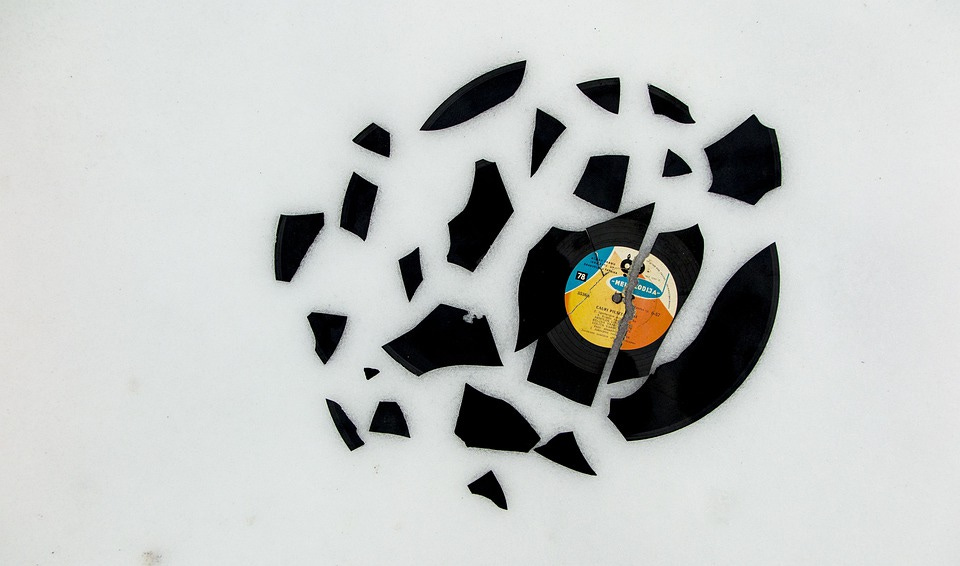
In the last, say, fifteen years, there has been an unfortunate renaissance in the consumption of vinyl by music lovers, and everyone from musicians to hipsters and activists to the die-hard music critics who were around when Mick Jagger still had his original knees is abetting it. In every way, the whole thing seems like a bad idea.
Arguments For Vinyl Which Are Probably Decidedly Straw-Man
Now, without interviewing people who claim to like vinyl, I’ll first address some of the more common arguments in favour of it (spoiler alert: most of them revolve around aerobic status-seeking or rationalization for settling for less quality at a higher price).
The first is that vinyl lovers swear that vinyl has a “warmer sound”. This tends to baffle sound engineers until they realize that “warmer sound” is a euphemism for high-end analogue loss and hisses, warbles, crackles, and pops. The easy snapback is to point out that that’s what graphic equalizers are for, and buying one to get the sound you want while consuming music on CDs or digitally is going to save you way more money in the long run. Plus, if these putative vinyl-saviours want to preserve their “warmer sound”, they need to do a lot of maintenance, some of which involves limiting the number of times you play the record. Okay. That’s a restriction I’d never want if I didn’t have to settle for it.
The second argument is a vague hodgepodge of claims about tradition and authenticity or something like that, which as far as I can tell, is completely subjective. All my Frank Zappa and Mothers of Invention releases are in remastered form on digital media, and speaking for myself, if I can consume the music, it’s as authentic as I’ll ever need it to be. And as far as “tradition” is concerned, those who hew to that argument are probably forgetting that bloodletting, blacksmiths, public executions, snake oil, and perceptions of women as nothing more than kitchen-chattel were also “traditional”. Older doesn’t mean better by any stretch.
Now, the third is one I can sympathize with somewhat. It’s the exhortation toward owning physical copies. Albums are a form of art themselves just with the presentation, and you get posterity out of it since the music is never going to run away from the disc. But again, you have a problem: compact discs can have their content easily translated into digital form, and though they are subject to decay, it’s never because of overplaying.
But physicals are also part of your aesthetic human presentation. One of the first things I do when I visit an artist’s dwelling (I’m loath to say “house”) is run right to the bookshelf or the music collection. I like my physicals, too. I still have tons of books and I own literally thousands of CDs. But the moment I find out that they’re wreaking environmental havoc and that there’s an equally palatable alternative, I’ll switch. Simple as that.
I’d also like to add that vinyl was, in fact, central to DJ culture and the origin of sampling, but that’s not quite my focus so much as leisure consumption. Plus, it can be argued that that’s not necessary either because of Traktor and Serato.
And Now…All The Reasons Consuming Vinyl is Bunk in 2021
Vinyl has a number of serious handicaps that can’t be ignored by concerned consumers in the new millennium. Of course, many consumers say they’re concerned, but not enough to stop this gratuitous practice. So why should they? Well…
1. It’s going to be way worse for the environment in the long run. A lot of these bohemian hipster types who swear by vinyl are the selfsame who are tonedeaf to irony when they appear at every environment protest they hear about. Think about this: the closer it is to nature, the more prone it is to decay and being broken down into constituent elements that can be used for the benefit of the natural environs, right?
So when someone buys vinyl, for the purposes of this argument, there are two entities present: the human and the record. Humans are only around alive for, say, eighty years or so. And after they’re dead, they’re certainly not around in any corporeal form for too long. So let’s say eighty years and two weeks, all told, from cradle to worms. Vinyl, on the other hand, is around for hundreds if not thousands of years, and because it’s a synthetic polymer, any decomposed elements are bound to be decidedly bad for the surrounding environment.
What this basically means is for the ten years that you’re still hip before your gut starts to sag and you’re taking your toddler to daycare in your decade-old Tercel, you’re costing millennia of waste. (NB: The same applies for CDs, but they have a number of advantages over vinyl).
2. They are oh-so delicate. Vinyl warps if it’s too hot. Vinyl cracks if it’s too cold. Any vinyl left on its side is prone to being knocked over and shattered. That’s because of the sheer size of an album. You could drop a CD from the same height without incident, except maybe a scratch, which won’t necessarily ruin a CD. Vinyl, on the other hand, can scarce withstand any buffs or scratches before you’re hearing the same half-bar over and over.
3. It’s costly. And not just in the fiscal sense, either (although this, I’m sure, is lost on people who will spend three hundred dollars on a sleeve tattoo when it could go toward literally anything else). As of last year, Americans are spending more on vinyl than on CDs, but not at the same unit rate. Not even close. At the end of the eighties and into the nineties, vinyl cost about four bucks apiece, presumably because everyone was wise to all the advantages of CDs. Now, they cost on average about $30 USD apiece, and a lot of it is due to overwhelming demand, and nothing more.
Why the skyrocketing prices? Because it’s harder for vinyl manufacturing to keep up with the same demand as CD manufacturing, and a rudiment of economic theory is that scarcity plus demand equals breaking the bank (for more information on this, go to eBay, and in the search field, type “beanie babies”). There are also the externalities: think of all the extra material and electricity that have to go into the manufacturing of these products, and don’t forget: plastic is a product of oil, so the whole thing winds up basically being an environmental disaster.
4. It doesn’t sound better. Come off it. If you don’t believe me, listen to any vinyl in hi-fidelity next to its lossless digital counterpart. You will never be able to eliminate the analogue limitations even if you have a fresh-out-of-the sleeve album and the finest stylus money can buy. There’s still way more handshaking happening between the grooves and your ear than there would be on any competing format.
You Spin Me Right ‘Round…
Now, I would be both remiss and curmudgeonly if I didn’t mention that I’m not “angry” at vinyl, nor do I wish to berate those that consume vinyl for purely aesthetic reasons (although I admit, being a passionate music lover, I can’t relate). But seriously. The sound isn’t better. You can still get physicals with CDs. They cost way more. They degrade. They’re bad for the environment. I just think that if you’re one of those types that thinks you’re offsetting carbon emissions by not eating meat but you’ll still join an absurdly long lineup to get $20 vinyl on Record Store Day, aside from giving a local business revenue, you’re part of that problem.
- Zero of the clan Grav,
06/01/21.